
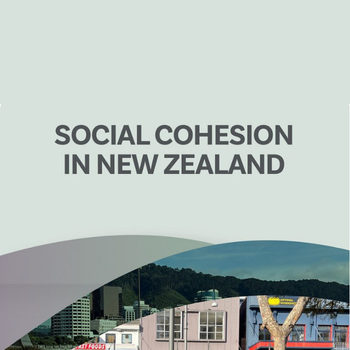
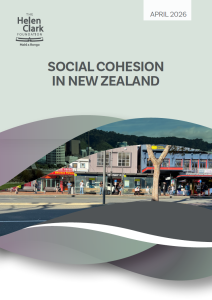
The Helen Clarke Foundation – April 2026
A new report from the Helen Clark Foundation on the state of social cohesion in our country shows rising opposition to immigration, falling trust in government, and rising loneliness. New Zealand appears to be sliding backwards on every factor that measures social cohesion.
“The size of the alienated group in the survey is quite staggering. It’s over a quarter and moving towards a third of the population. That’s a huge worry, because with alienation comes anger, comes despair. It can lash out in ways you can’t predict. It’s particularly fertile territory for populism to stir.” – Helen Clark
The social and community sector, from sports clubs to marae and community groups, are more important than ever in their role of bringing people together and addressing inequality, when philanthropic funding is used to meet basic needs.
Report Findings
Social cohesion is the foundation on which New Zealand navigates complexity and challenges. Our second annual Social Cohesion Survey finds that cohesion in New Zealand has slipped across every dimension measured — but there is also reason for hope.
Trust is at a record low – Only 2 out of 5 New Zealanders trust the government to do the right thing. Trust in the courts has fallen from 57% to 45% in a single year, the biggest drop in the survey.
Safety is not equal – Only 45% of women feel safe walking alone at night, compared to 69% of men.
We are getting less hopeful – The share of New Zealanders who see the country as a land of opportunity fell from 51% in 2024 to 45% in 2025. We are becoming less hopeful, not catching up.
The Three New Zealands
Using two years of survey data we’ve identified three distinct groups who experience New Zealand very differently. Hover or select a circle below to learn about each group.
The Connected 30%
They feel they belong and feel valued, trust the system to be fair, and they are warm towards New Zealanders who are different from them. They score the highest of any group on belonging, on self-worth and on acceptance of others. And they aren’t very likely to participate in community, religion and politics.
The Ambivalent Middle 41%
The largest group that contains most of the country’s older homeowners, retirees, and centre-right voters. They are materially comfortable, happy, but not deeply connected to the social fabric. This is the group that also feels it first when economic conditions worsen or political discourse becomes more divisive.
The Alienated 28%
There is a large group that is disconnected from the promise of our country. They feel alienated but show oppositional activity and participation. They participate in a range of activity from protesting to posting online, as well as report low belonging, low acceptance of other New Zealanders, and the highest sense that the system is unfair. They are the loudest voices in our public conversation, and the ones most likely to feel the country is not for them.
What can be done?
Social cohesion is slipping, but small actions can bring us closer together.
Friendship across cultures builds belonging
People with close friends from a different ethnic or religious background consistently report a stronger sense of belonging. The good news is that 83% of New Zealanders already have at least one. The connections are already there in our workplaces, schools, and neighbourhoods. We just need to strengthen what already exists.
Belonging keeps people connected, even under financial pressure
New Zealanders who are struggling financially but still feel a strong sense of belonging stay involved in their communities at similar rates to those who are comfortable. Belonging does not fix poverty, but it changes what poverty does to people’s connection to the world around them.
Young people are a resource
Young New Zealanders experience the worst outcomes on almost every measure in this survey — but they are also the most hopeful age group. They have not given up on the idea that things can improve. That matters, and it is something we should make the most of.
Diverse media diets matter
People who get their news from a wide range of sources, traditional and social, report the best social cohesion outcomes. Media literacy and diverse consumption habits are protective.
Home ownership anchors belonging
Homeowners show 7.4 percentage points higher civic participation and 14 points higher neighbourhood belonging than renters. With about half of adults now renting, housing policy is cohesion policy.
Financial stress is the dominant driver
No amount of community programming can compensate for economic policy that leaves people behind. Financial stress predicts low belonging, low trust, high isolation, and negative attitudes to immigration more than almost any other variable.
This project is made possible through funding by The Simplicity Foundation, The Tindall Foundation, The Todd Foundation, Internet NZ, NetSafe, and The Wayne Francis Charitable Trust. This funds the survey work.
The research, analysis, production, and hosting of this work is provided on a pro bono/at own cost basis by The Helen Clark Foundation and Shamubeel Eaqub.
